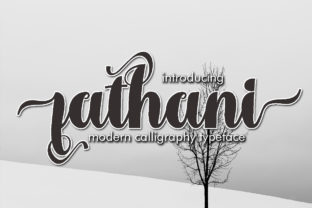
The Return of the Mark: Why Fathani Is Reshaping How We Think About Calligraphy in Modern Design
There is a quiet but unmistakable shift happening across branding studios, editorial layouts, packaging designs, and digital interfaces. After years of geometric sans-serifs and sterile minimalism, designers and their clients are rediscovering the power of the hand-drawn mark. At the center of this renewed attention sits Fathani, a contemporary calligraphic approach that takes the discipline's classical roots and bends them toward entirely new possibilities. It is not simply a typeface or a stylistic flourish. It is a design philosophy that bridges centuries-old craft with the demands of modern visual communication.
What Fathani Actually Is
To understand Fathani, it helps to first set aside the assumption that calligraphy belongs in glass cases or wedding invitations alone. The term refers to a specific interpretive method within calligraphic design—one that preserves the structural integrity and rhythmic discipline of classical scripts while introducing deliberate, controlled disruption. Letterforms in the Fathani tradition retain their ancestral DNA: the swelling thicks and hairline thins, the balanced counter-spaces, the choreographed flow from one character to the next. But they also carry something unexpected. A fractured baseline. An asymmetrical ligature. A weight distribution that defies conventional proportion. A tension between precision and spontaneity that feels distinctly contemporary.
Practitioners of Fathani often describe their process as one of respectful rebellion. They study historical models intently—Arabic scripts like Diwani, Thuluth, and Naskh, as well as Latin calligraphic traditions rooted in Copperplate and Spencerian forms—and then deliberately push against their boundaries. The result is work that feels alive, breathing, and slightly unpredictable. It carries the gravitas of tradition without the stiffness of museum-piece reproduction.
A Broader Creative Current
The emergence of Fathani as a recognized approach does not exist in isolation. It belongs to a larger creative current that has been steadily gaining momentum for the better part of a decade. Across disciplines, there is a growing appetite for what might be called considered imperfection. In interior design, it surfaces as wabi-sabi principles applied to Western contexts. In photography, it appears in the resurgence of film grain and analog processes. In typography and lettering, it manifests through a rejection of the pixel-perfect, mathematically flawless forms that dominated the early 2010s.
Fathani updates classic calligraphy with a modern twist precisely because it speaks to this moment. It understands that audiences have developed a sophisticated eye. They can sense when something has been too mechanically smoothed, too algorithmically optimized. The slight tremor in a Fathani stroke, the deliberate variation in ink density, the way a terminal curve refuses to close perfectly—these are signals of human presence. And human presence is what contemporary consumers, whether they articulate it or not, increasingly crave.
Market Forces and the Search for Distinction
From a commercial perspective, the attention paid to Fathani makes complete sense. Brands today face a visibility crisis. The tools of design have been democratized. Templates, generative AI, and accessible software mean that polished visuals are no longer a differentiator—they are table stakes. In this environment, the search for authentic distinction becomes urgent.
Calligraphic work rooted in the Fathani approach offers something that template-driven design cannot replicate: genuine singularity. Each mark bears the imprint of a specific hand, a specific moment, a specific set of material conditions. Even when digitized and vectorized, the original organic quality persists. For luxury brands, hospitality groups, artisanal food producers, and cultural institutions, this is invaluable. It allows them to signal heritage, craft, and individuality in a visual language that reads as both timeless and immediate.
Consider a boutique coffee roaster launching in a crowded urban market. Their competitors all use clean, sans-serif logos with muted color palettes. By commissioning a wordmark developed through Fathani-inspired calligraphy, they immediately occupy a different perceptual space. The logo suggests patience, artistry, and a connection to something older than the latest design trend. It carries cultural weight without feeling nostalgic or out of touch.
Changing Workflows and Expanding Possibilities
The relevance of Fathani is also tied to significant changes in how creative work gets produced and consumed. A decade ago, incorporating custom calligraphy into a commercial project meant navigating serious logistical hurdles. The turnaround was slow. The costs were prohibitive for all but the largest clients. The translation from physical artwork to usable digital assets was cumbersome and often resulted in a loss of fidelity.
Those constraints have largely dissolved. High-resolution scanning technology, advanced vectorization tools, and sophisticated design software now allow calligraphers working in the Fathani tradition to produce work that moves seamlessly between physical and digital realms. A piece can begin as ink on handmade paper, be captured at archival quality, refined in a vector environment, and then deployed across a responsive website, a mobile application, animated social content, and large-format environmental graphics—all while maintaining the integrity of the original hand.
This workflow flexibility has broadened the addressable market considerably. Fathani is no longer confined to print and static applications. Motion designers are incorporating its fluid letterforms into kinetic typography pieces. UI designers are exploring how calligraphic principles can inform interface elements. Packaging designers are using it to create unboxing experiences that feel ceremonial. The method travels across media without losing its essential character.
The Human Answer to Automation Anxiety
There is another layer to the growing prominence of Fathani that deserves attention, and it has less to do with aesthetics than with psychology. The creative industries are currently navigating a period of profound technological disruption. Generative AI tools can produce entire brand identities in seconds. Automated design platforms promise to eliminate the need for professional designers altogether. For many practitioners and clients alike, this raises uncomfortable questions about value, authorship, and meaning.
Hand-rendered calligraphy—and the Fathani ethos specifically—offers a compelling counter-narrative. It insists that process matters. That the hours spent mastering a ductus, the physical relationship between hand and tool, the small accidents that become signature elements, all contribute to a result that cannot be replicated by prompting an algorithm. This is not a Luddite position. Many Fathani practitioners integrate digital tools thoughtfully into their process. But the foundational gesture remains irreducibly human.
For clients, investing in this kind of work becomes a statement. It says that they value craft. That they understand the difference between the merely novel and the genuinely enduring. In a commercial landscape increasingly saturated with synthetic imagery and auto-generated content, that stance carries real weight.
Practical Observations from the Field
Designers who have begun incorporating Fathani-influenced calligraphy into their projects report several consistent observations. First, client reception tends to be strikingly emotional. Where a conventional logo presentation might elicit nods and analytical discussion about scalability, a Fathani-inspired wordmark often provokes a more visceral response. Clients feel something before they think something. This emotional primacy can be enormously valuable in securing buy-in and building brand attachment.
Second, the approach tends to reward restraint in surrounding design elements. Because the calligraphic mark itself carries so much texture and personality, it often functions best when given room to breathe. Layouts built around a Fathani wordmark frequently lean into generous whitespace, simple typographic hierarchies, and minimal color palettes. The calligraphy does the heavy lifting. Everything else plays a supporting role.
Third, there is a notable longevity effect. Trends in graphic design cycle quickly. What looks fresh today can feel dated within eighteen months. Calligraphic work grounded in classical structure, however, tends to age gracefully. Because it draws on forms that have evolved over centuries, it possesses a natural immunity to the churn of micro-trends. A brand identity built around Fathani principles is less likely to require a premature overhaul than one built around the typographic flavor of the month.
Connecting to Larger Developments
Zooming out, the trajectory of Fathani connects to several significant structural developments. The first is the ongoing recalibration of the relationship between global and local. As supply chains, media platforms, and technology ecosystems become increasingly homogenized, there is a countervailing hunger for specificity. Calligraphy—always rooted in particular scripts, cultures, and material traditions—offers a direct conduit to that specificity. Fathani, by honoring classical foundations while remaining open to contemporary inflection, sits at the intersection of heritage and relevance.
The second development is the maturation of the experience economy. Consumers, particularly in premium segments, no longer buy products in isolation. They buy stories, rituals, and sensory journeys. A calligraphic mark, with its visible evidence of the human hand, contributes texture to that journey. It suggests that someone cared enough to make something by hand, and that suggestion colors the entire perception of the brand.
The third development involves the changing role of the designer. As automation handles more production tasks, the designer's value shifts upstream—toward curation, conceptual thinking, and the ability to make nuanced aesthetic judgments. Understanding traditions like Fathani, knowing when to deploy calligraphic elements and when to hold back, becomes part of that higher-value skillset. It is not about being able to execute every script perfectly. It is about developing the literacy to commission, direct, and integrate calligraphic work intelligently.
Looking Ahead Without Speculation
What can be observed without venturing into prediction is that the conditions supporting interest in Fathani are structural, not faddish. The desire for human connection in designed objects is unlikely to diminish. The competitive pressure for brands to differentiate meaningfully will only intensify. The tools that make custom calligraphy practical for a wider range of projects will continue to improve.
What may evolve is the specific vocabulary of the approach. New generations of calligraphers, trained in both classical forms and digital environments, will develop their own dialects. They will push the tension between tradition and disruption in directions that current practitioners have not yet imagined. The name Fathani may or may not remain the label of choice, but the underlying impulse—Fathani updates classic calligraphy with a modern twist—describes a creative trajectory that shows every sign of continuing.
Integrating the Approach Into Your Own Projects
For creative professionals, entrepreneurs, and brand stewards wondering how to engage with this tradition, the starting point is education. Spend time looking at historical calligraphic exemplars. Understand the structural logic behind the scripts that interest you. Notice how weight moves through a letterform, how spacing creates rhythm, how the tool angle shapes the mark. This literacy will inform everything that follows.
From there, consider collaboration. The most successful Fathani-informed commercial work typically emerges from genuine partnerships between calligraphers and designers who respect each other's expertise. A calligrapher brings deep knowledge of ductus, proportion, and gesture. A designer brings context—understanding of the brand strategy, the audience, the media environment, and the functional requirements the mark must fulfill. When those perspectives meet productively, the result transcends what either party could achieve alone.
Finally, resist the temptation to over-tame the work. The power of Fathani lies partly in its willingness to retain the irregular, the imperfect, the evidence of process. Over-digitizing, over-polishing, or forcing every curve into geometric compliance strips the approach of its essential character. Trust the hand. Trust the tradition. Let the mark breathe.
The Deeper Significance
At its core, the story of Fathani is not really about a style. It is about a recalibration of values within visual culture. After a prolonged period in which efficiency, consistency, and scalability dominated design thinking, there is a renewed appreciation for qualities that resist easy quantification. Texture. Presence. The warmth of the human trace. The resonance of forms that carry history within them.
Calligraphy has always been, at its best, a discipline of attention. It demands that the practitioner be fully present. It rewards patience and punishes haste. These are qualities that contemporary culture, for all its speed and convenience, still deeply needs. That Fathani updates this ancient discipline for modern application is not a gimmick or a passing novelty. It is a recognition that some things—beauty, meaning, the mark of the hand—do not become obsolete. They simply find new forms.
Whether you are developing a brand identity, designing a publication, crafting a digital experience, or simply cultivating your own creative practice, the principles underlying Fathani invite a productive question. What would happen if you slowed down, picked up a tool, and made something that only you could make, in the way that only you would make it? The answer, increasingly, is what audiences and markets are most eager to see.